Art, Music, Architecture School
Kunst, Arkitektur, Musikk (KAM)Solo 3rd year NTNU Complex building course 2017.
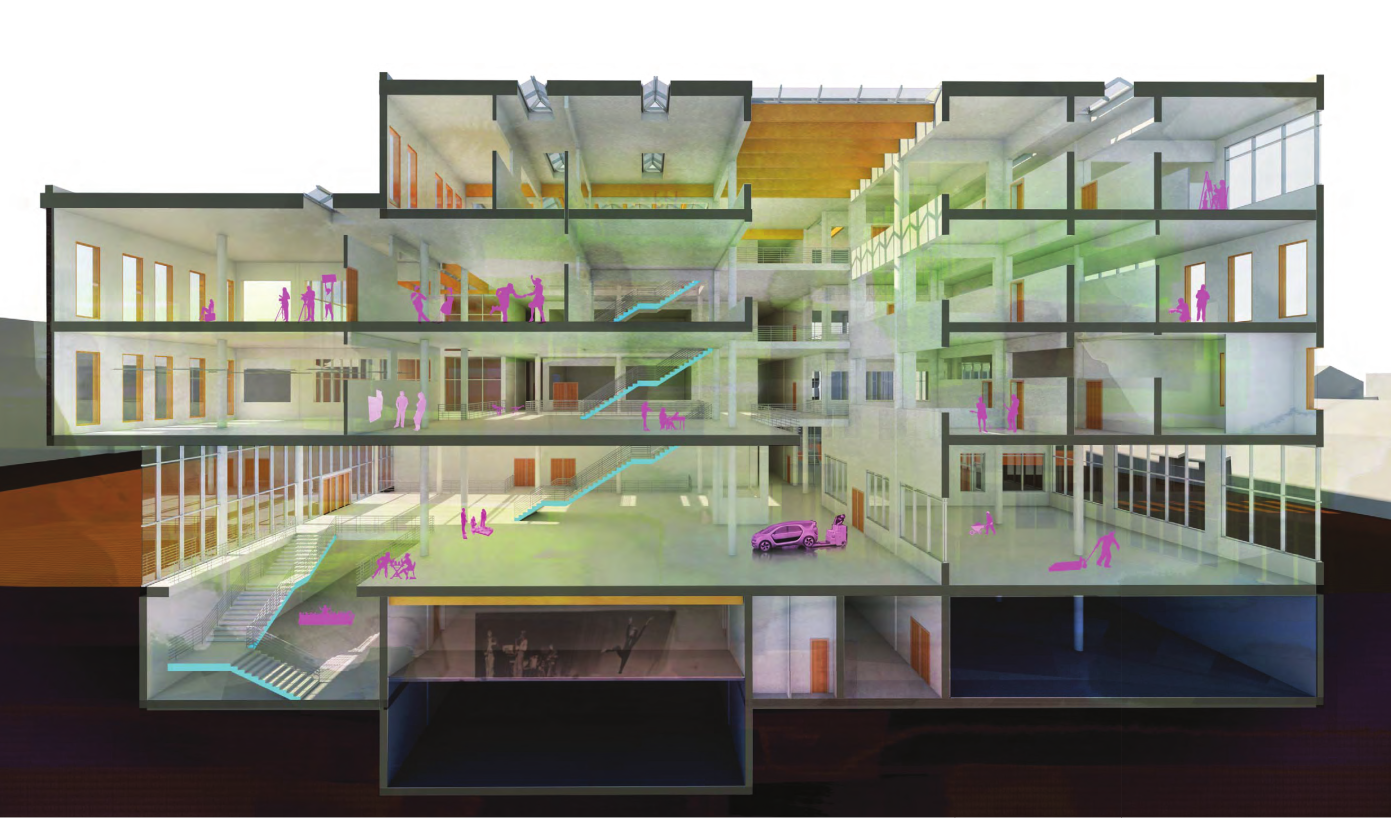
The project is the integration of the architecture, music, and art faculties under one roof and into the urban setting of Leutenhaven neighbourhood of Trondheim, Norway. Currently, the faculties are disparate around the city and without any useful synergy among the students and faculty. An integrated campus can bring about collaboration among the faculty and with the public.
Used Revit and Rhino3D as the primary tools. Photoshop, Illustrator, Indesign for illustrations.
The project is the integration of the architecture, music, and art faculties under one roof and into the urban setting of Leutenhaven neighbourhood of Trondheim, Norway. Currently, the faculties are disparate around the city and without any useful synergy among the students and faculty. An integrated campus can bring about collaboration among the faculty and with the public.
Used Revit and Rhino3D as the primary tools. Photoshop, Illustrator, Indesign for illustrations.

Design Process & Goal
We held an interview session with art and music students to obtain program and use requirements. Wooden blocks simulated the program along with the different ceiling height requirements.
Integration of the three faculties together and design spaces for sharing and visibility is the main goal. The students should be able to communicate with each other, faculty, and the public. Many of the student spaces and exhibition area face the street, letting the public know the activities in the building.
Bottom-Up Form Finding
The building's form were found using the bottom's up approach: start with program and the rooms dictate the facade formation.Facade and form were found by different blocks of materials.
Transparent/opaque, hard/soft, tall/short effects that were provided by acrylic blocks, wood, and plastic netting.
A final laser-cuttet model imprinted the brick texture and a thin strip of MDF placed in the window gave shadow and texture on the wall.


Collectiveness & Verticality
Collectiveness is achieved by grouping common spaces together; centered around the atrium, canteen, and staircases. Large aperatures allow visibility into the upper levels and the basement which increases the feeling of collectiveness. The atrium, foyer, and library are examples of stacked floor space. The basement is sound insulated, appropriate for the music studios and lecture hall.